[ENG] INTERVIEW. Lublin on Its Way to ECoC
From Dreams to Re:Union: Lublin on Its Way to ECoC
Else Christensen-Redzepović in a conversation with Marta Ryczkowska
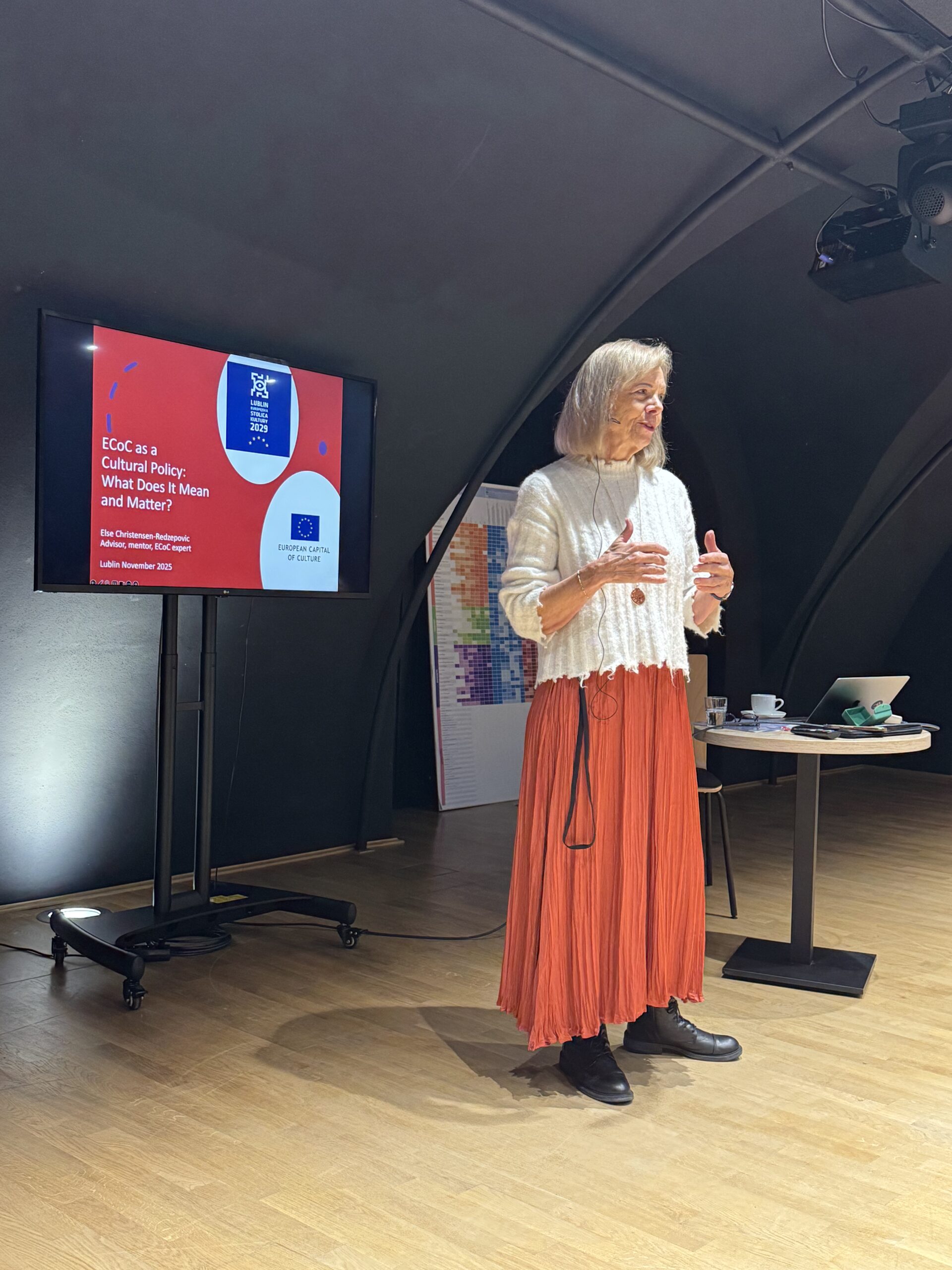
We meet with Else Christensen-Redzepović to discuss the European Union’s most important cultural initiative,one that builds a shared European identity, strengthens social cohesion, and supports cross-border cooperation. Lublin is now among the cities actively engaged in this process. In 2029 it will become a European Capital of Culture, yet the journey toward this title began the moment the city was announced as the winner of the competition.
This is a long-term programme that truly transforms cities: their image, infrastructure, social relations, and international connections. When speaking about the responsibility that comes with the title, it becomes easier to define what it is not. It is certainly not a festival of festivals. It is not a marketing overlay. As the expert reminds us, a city is selected as an ECOC solely on the basis of what is written in its application (the bidbook), after meeting clearly defined criteria. The city commits itself to delivering the programme, projects, and budget described therein.
We are currently in a crucial transition phase—from the aspiration-driven period of planning and conceptualisation to the methodical and consistent implementation stage. The main challenge lies in managing the shift from the dreamlike unity of the bidding phase to the complex, polyphonic reality of executing the project. Else explains how essential groundwork is for this process: continuous communication, consistency, and empathy.
Marta Ryczkowska: A year has passed since Lublin was awarded the title of European Capital of Culture, and we now need to start implementing what we outlined. I’m speaking with our dear friend and expert, and I’m curious about this moment between having the title – the phase of dreams and concept development captured in the bidbook – and the slow transition to the more challenging phase of implementation. Could you talk about the division between these phases and how you approach them? How do you see people’s roles during the application phase versus the implementation phase?
Else Christensen-Redzepović: It depends on the city; every European Capital of Culture is different. Typically, during the bidding phase, there is enthusiasm: everyone is motivated because the competition is underway. Once the title is awarded, however, success emerges with many fathers and mothers, and this often sparks new competition for influence. Everyone wants to play a significant role, and political pressures often come into play.
That is why it is crucial for a city applying for the European Capital of Culture title to discuss these issues before receiving the good news. You want to be able to say: If we receive the title, we act like this; we have a prepared plan to follow. It may sound idealistic – and indeed, few cities have such a document, because during the application phase hundreds of other matters demand attention. Yet when the announcement comes, it is best to be able to take that plan as a carefully prepared map and say: Alright. Now we follow what we have outlined.
First, you need to get a full overview of the situation – literally mapping out the entire project. This is a huge undertaking entrusted to you. The European Capital of Culture will be the largest project you have ever worked on. For those who stay with the organization until the end, it will undoubtedly be a major milestone in their careers. Instead of panicking or improvising, it is worth sitting at the table with the newly appointed CEO, artistic director, COO, CFO, the team, the mayor, and the chair of the panel, ensuring that everyone understands the objectives, knows their roles, and what they are responsible for.
You need a very clear work plan, starting from the day the title is awarded and running through to the end, marking every activity and task that must be implemented. You also need a routine of regular meetings, where key individuals report on progress since the previous month, to ensure the plan is being followed and avoid unpleasant surprises. This is a very practical approach. It is also important to draw knowledge from other ECOC cities that have already gone through this process. I would suggest handling this in a very structured way: organize meetings for people in equivalent roles – CEO with CEO, artistic director with artistic director, international relations officer with their counterpart in another ECOC. This way, you can learn from both their successes and failures, and they will surely have plenty of advice and practical tips that can be useful.
Often, at the moment the title is awarded, it is still unclear who will be the CEO or the artistic director. But now is that moment: we have the title, and now we must act. It is better to invest time and resources immediately than to struggle later with internal conflicts, city polarization, or a situation where one person does not know what another is doing. Without proper communication with stakeholders—about what will happen and what their roles are—frustration arises quickly, leading to disengagement from the ECOC organization. This is precisely what we want to avoid.
In practice, ECOC cities often experience internal friction: CEOs leave, artistic directors resign, communication managers depart—usually because proper team management and communication were not addressed in a timely manner. Therefore, transparency and open communication are absolutely key. From what I understand, you have already started informational workshops. Continuing these, inviting stakeholders at regular intervals and updating them on the progress of activities, would be an excellent move.
Over the years, you’ve observed the evolution of ECOC projects. We’ve talked about how the application phase and the implementation phase have changed dramatically over time, especially in recent years. What significant changes would you highlight—in management, programming, community engagement, communication, and so on? What strikes you the most?
Do you mean what could go wrong and what could be done better? A key issue is that external staff are often hired without a clear explanation of their role. This easily leads to frustration, especially when people realize, for example, that the artistic director’s role is relatively limited.
Why does this happen? Because a city is selected based on the bidbook – the final application. Not because you have a beautiful city. Not because you hosted us wonderfully during the site visit. Not because you are nice. Not for geopolitical reasons. You were chosen solely based on what you wrote in the bidbook, because it met the criteria. The selection process is very technical. Three competitors did not receive the title, even though their applications were also strong.
That is why the bidbook must be treated like a tender – it is, in effect, a contract to be fulfilled. For the people who wrote the application, this is obvious because they know the criteria. But for many others—team members, partners, the community – it can be a big surprise. And that is exactly why it must be communicated continuously. This is also the best defense when someone says, We have a fantastic project idea! You can respond: That’s a wonderful idea, but the bidbook already defines the program and budget we must implement. If additional funds become available, we can consider new initiatives.
You must ensure that all information reaches every stakeholder, including politicians. The mayor and key decision-makers need to be fully aware of the situation. And it is not enough to tell them once, you need to repeat it over and over, because the panel will monitor whether you are truly delivering what you promised. We will check that you are doing what you committed to.
Of course, minor changes will occur along the way, after all, it’s now 2025, and the project will be implemented in 2029. Some curators may, for various reasons, decide not to continue working on the project. Individual events may take slightly different forms or develop new layers, but they must remain clearly recognizable and conceptually consistent with the Re:Union theme and the overall storytelling on which the city was selected.
If you fail to do this, the consequences can be serious: there may be public criticism, and Lublin could find itself in a negative position in the eyes of the European Commission and the European arts and cultural scene, which is well-informed about ECoC and the reputation of key figures. Those who choose not to follow the rules will be seen as having failed, and their decisions may also negatively affect the city authorities and other people in key positions.
To achieve success where everyone can feel pride and leave a lasting legacy, it is essential to follow the rules. Because if you decide not to respect them, why did you bid in the first place? In that case, you might as well organize a regular festival or another type of event. And it is often repeated that the European Capital of Culture is not a festival. Festivals are entirely different – they are short-term, often spectacular, but they do not produce social change or build lasting structures.
What advice would you give to those who think that the European Capital of Culture is just another festival featuring big stars?
Communication, communication, communication. You need to make it clear to everyone: the European Capital of Culture is not a festival, it’s not about big fireworks displays. It is a year-long program that gives Lublin and its region, together with all partners, the opportunity to implement real social changes and urban transformations, to connect the city with diverse European cultures, and to learn from one another. For people from other countries, it’s a chance to come to Lublin, explore the richness of the local culture, and co-create projects.
The European Capital of Culture initiative was established 40 years ago as a tool for cultural integration—a way for people from different European countries to meet, learn from each other, and understand their cultural differences. This is the essence of the project, and it must be kept in mind not only in 2029 but throughout the entire preparation period and even after it ends.
ECOC is also different from a festival because it grows from the ground up, starting with the residents and local cultural sector who have contributed to building the program—the idea that earned the city its title. These are the people who should implement the planned activities, often in collaboration with European partners the city has cultivated over the years. Festivals, on the other hand, usually bring in external stars for a short performance to create a spectacular show. It’s beautiful and impressive, but it does not leave lasting change, build new skills, or raise social awareness. It is pure entertainment, headlines in the media, and nothing more.
You talk about changes in program leading, but I also notice significant transformations in how ECoC is managed, especially in the teams preparing the applications. I observed this during my research on Belgian candidate cities this year. The teams in Namur, Molenbeek, and Leuven had one thing in common: they were extremely diverse, empathetic, and their organizational structure was maximally horizontal. This facilitated communication and encouraged meetings on an equal footing. It clearly shows a new perspective on managing socio-cultural projects, based on collaboration and mutual understanding. It’s a kind of alternative way of building a world in contrast to the rigid reality of hierarchy and authority, a world we shape together, step by step. Of course, every country has its own specificity, but I notice a trend that I hope will continue to develop in other applying cities as well.
I come from Denmark, where structures are very flat, but when I visit other countries, I notice more formality and clear hierarchy. However, a European Capital of Culture can choose a different path; it can become a laboratory for new ways of managing a large project that develops the skills of everyone involved. Such an undertaking requires a lot of empathy, and the Re:Union theme naturally demands it. Historically, the European Union looked very different than it does today. When the idea of the EU was first developed, it was based mainly on economy, money, and steel, because these were the priorities for people after the war. Culture was overlooked, even though it should have been at the heart of the Union. Similarly, in Poland: if we want to redefine Re:Union, we can become pioneers in the region, showing that culture and contemporary values – mutual understanding, care, empathy – can become the foundation of our actions.
A good example from my country: in Denmark, schools have a dedicated hour for learning empathy. This doesn’t just happen once a week – the principle runs throughout the education system and is reflected in how children are raised. Empathy must be taught; it is not natural. Our world today needs more mutual care, both for each other and for our planet. And this fits perfectly with Lublin’s guiding theme. You can prove it if you decide that this is the path you want to follow.
Thank you very much, beautiful words to close with.
Kultura Enter
4. ROK WOJNY
2026
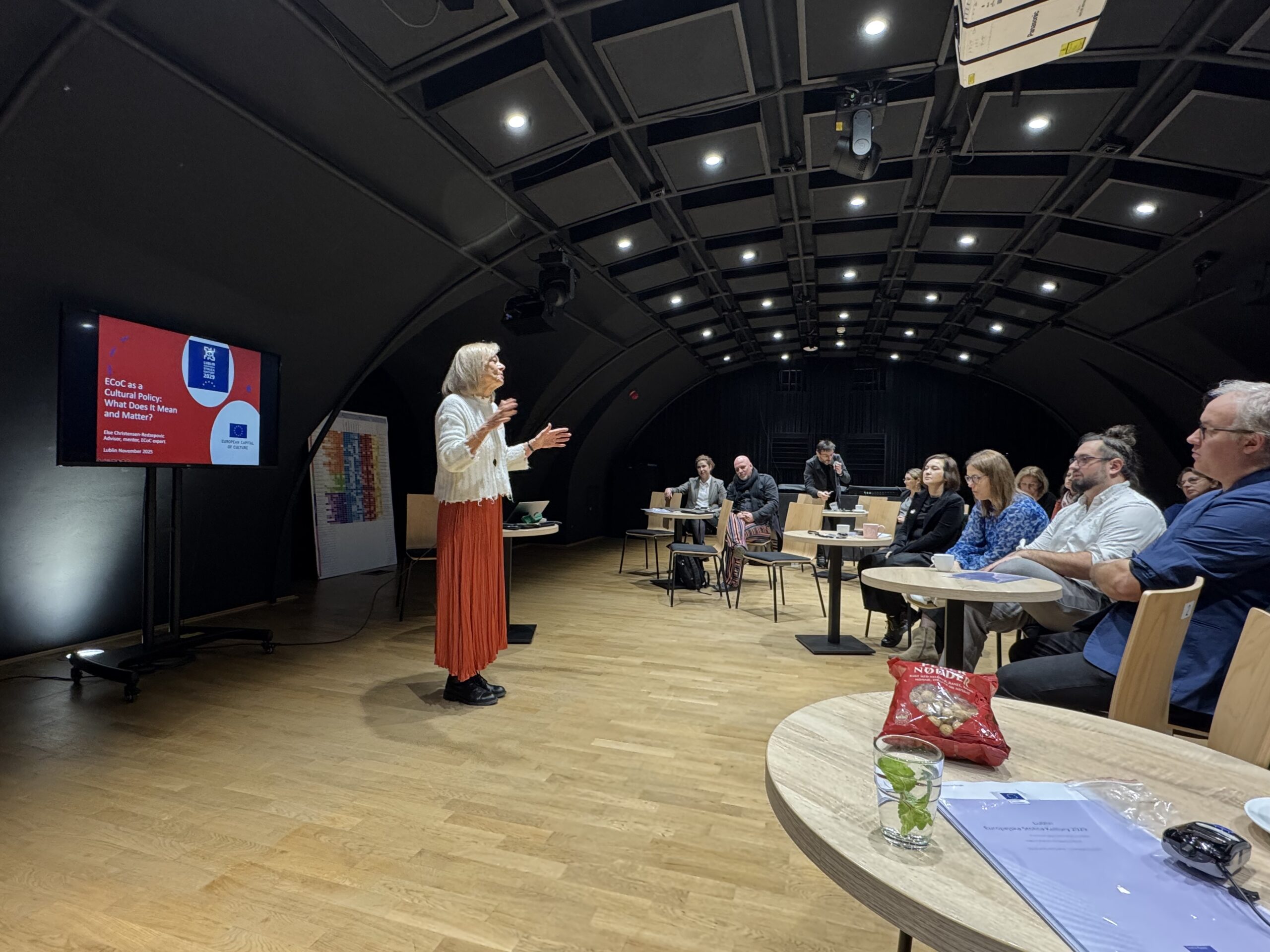
Else Christensen-Redzepović in Lublin, 2025. Photos courtesy of Centrum Kultury w Lublinie.
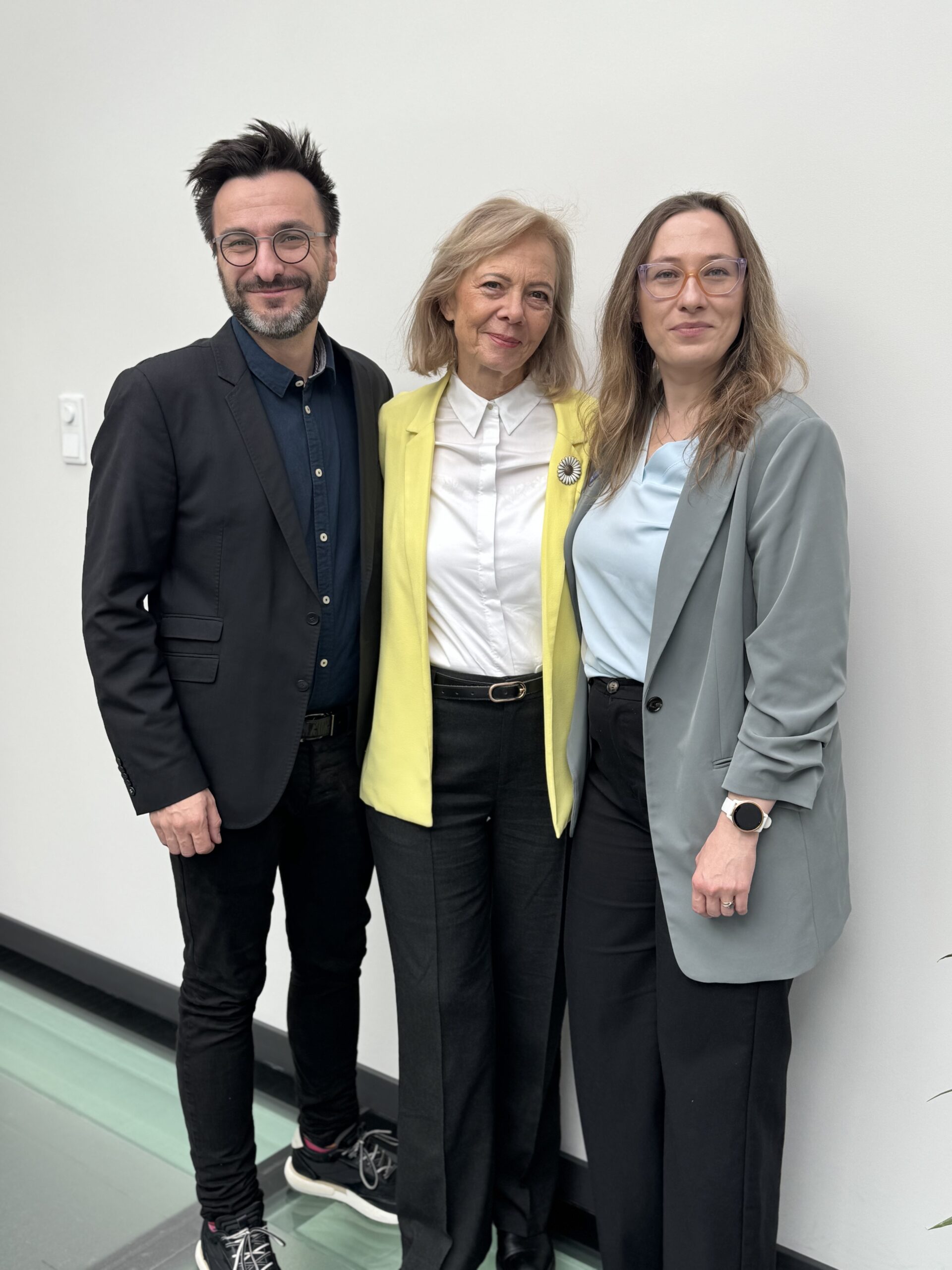
Else Christensen-Redzepović with Maciej Rukasz and Marta Ryczkowska from Lublin ECoC team.